Handicapping the Masters: A History of Gambling, Golf, and Augusta
When I was in college, if you wanted action you needed a bookie or a number you didn’t save to a guy who “got his lines” from USA Today. He had a name like Fast Tony, worked out of a pizza parlor, and he wasn’t pretending to crunch numbers. He was taking bets.
Today we carry him around in our pockets. A few taps and your bet is in. That ease is the point, and it’s also the difference.
I liked it better when it lived in the shadows. Until 2018, you couldn’t legally bet on sports outside Nevada. Then Murphy v. NCAA wiped away the federal ban and what used to require a handshake moved into the App Store.
Legal US sportsbooks handled roughly $150 billion in wagers in 2024, generating about $13 billion in revenue. New York alone accounted for more than $22 billion. And that’s just the regulated side of the ledger. The shadow market still exists, only now it runs parallel to the official one instead of replacing it.
You’ve probably noticed AI in the news; it got me thinking, how did your neighborhood book manage their lines before data science departments, predictive modeling, and real-time algorithms?
Because that machine is humming loud now. Sportsbooks spent more than $400 million on commercials last year to in a race for user acquistion. Betting odds sit on the same screen as highlights and box scores., and risk has automated to keep up with lead generation.
Even before automation, it had to be managed carefully, or a bookie wouldn’t be in business for long. Granted, they had a smaller handle, but would have protected it with every resource or advantage they could leverage.
How Bookies Set Masters Betting Lines Before Big Analytics
So before computers, what exactly did a bookmaker have?
Paper. Phone numbers of agents. Front office sources and boots on the ground, wrinkled sports pages and almanacs with any statistic that could help them stay sharp.
These were the thoughts going through my mind on the first Sunday of February, watching the Phoenix Open while building a group super bowl bet and flipping through a 1977 Masters press kit I had bought on eBay.
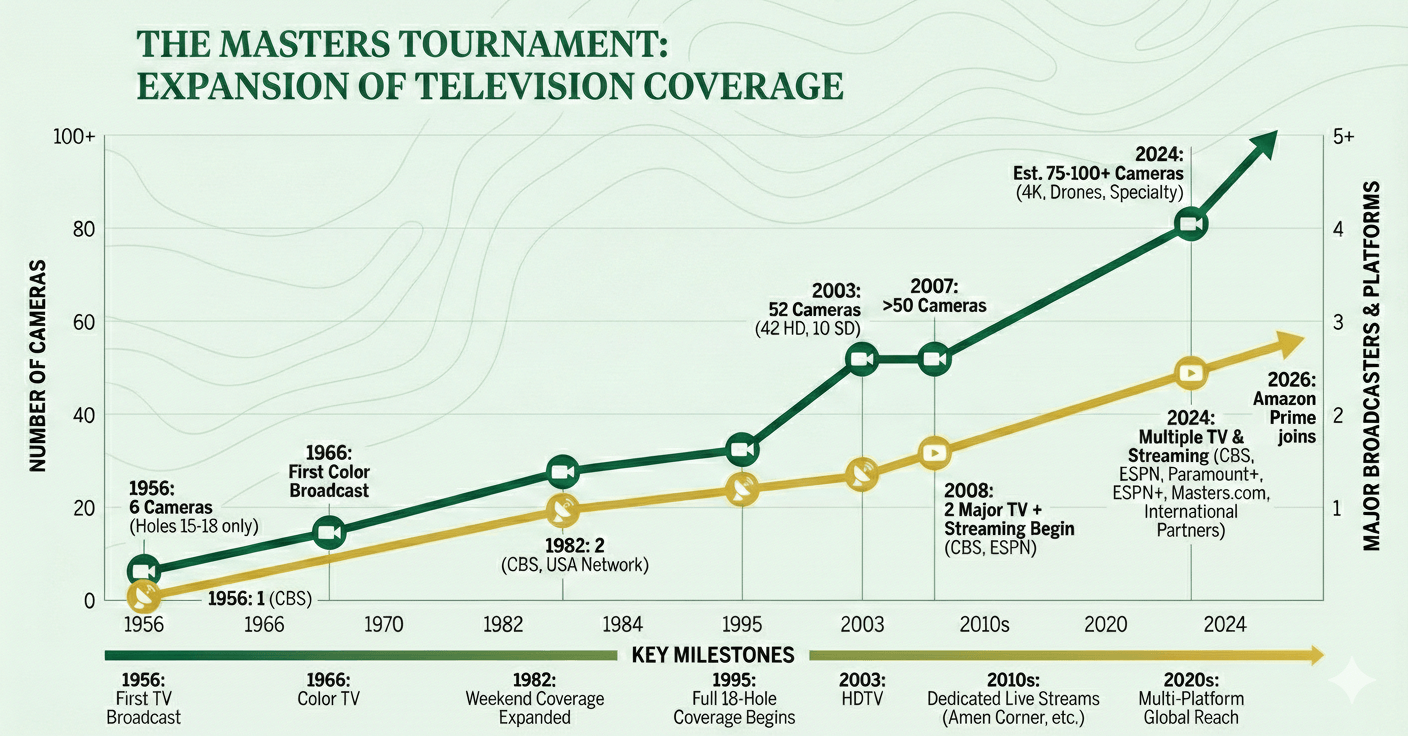
My favorite thing about this package is the story its pages tell about a different time. In 1977, the Masters had limited television coverage but it was still fervently popular. People were drawn to the broadcast but got most of their information from the local papers, and so did the bettors who tracked the action.
Holding these stapled packets of statistics I realized what I was holding were essentially handicapping sheets.
Pages of tour standings, money lists, scoring trends and historical Masters results. Just the type of information you’d like to get your hands on if you were taking bets.
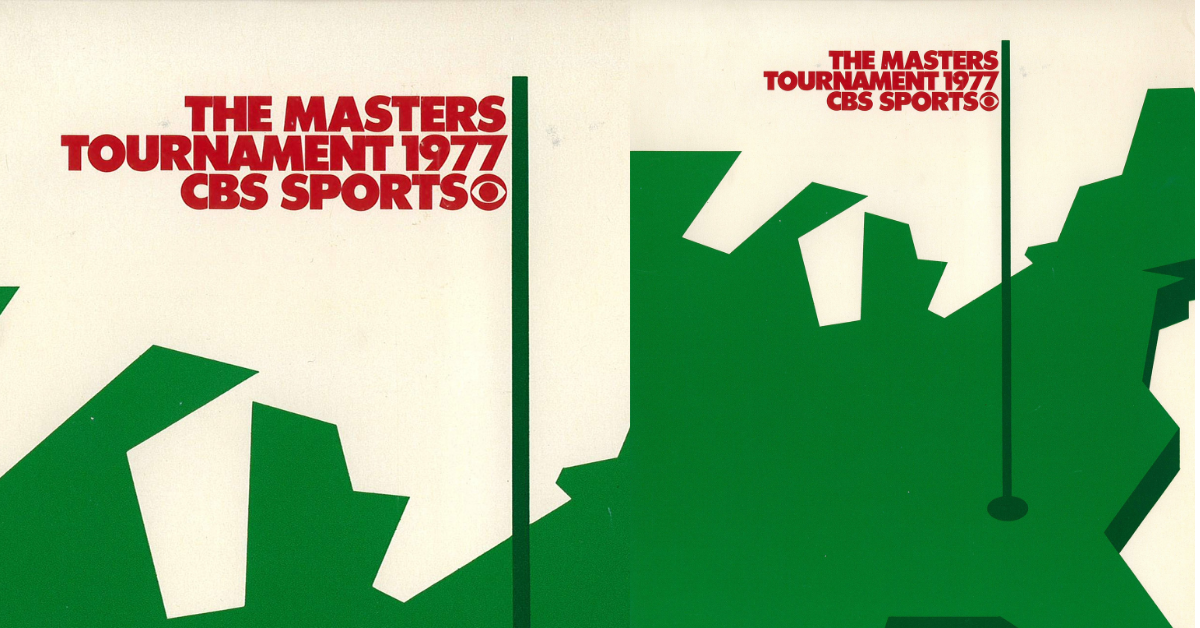
Front Cover of the CBS Sports Package from the 1977 Masters Golf Tournament
This same kind of data still moves markets today, though it has evolved. Open data, sabre metrics, and the advent of quants made sports data available to anyone who could model it, and the prediction markets started to surge.
But in the year of Yacht Rock and Led Zeppelin, how did the sharps find their edge? Did the press circulate Press Kits like these outside of their circle? Did copies drift into the right locker rooms and grill rooms of private clubs? Would it be old news once it hit the papers, having already been factored by Fast Tony?
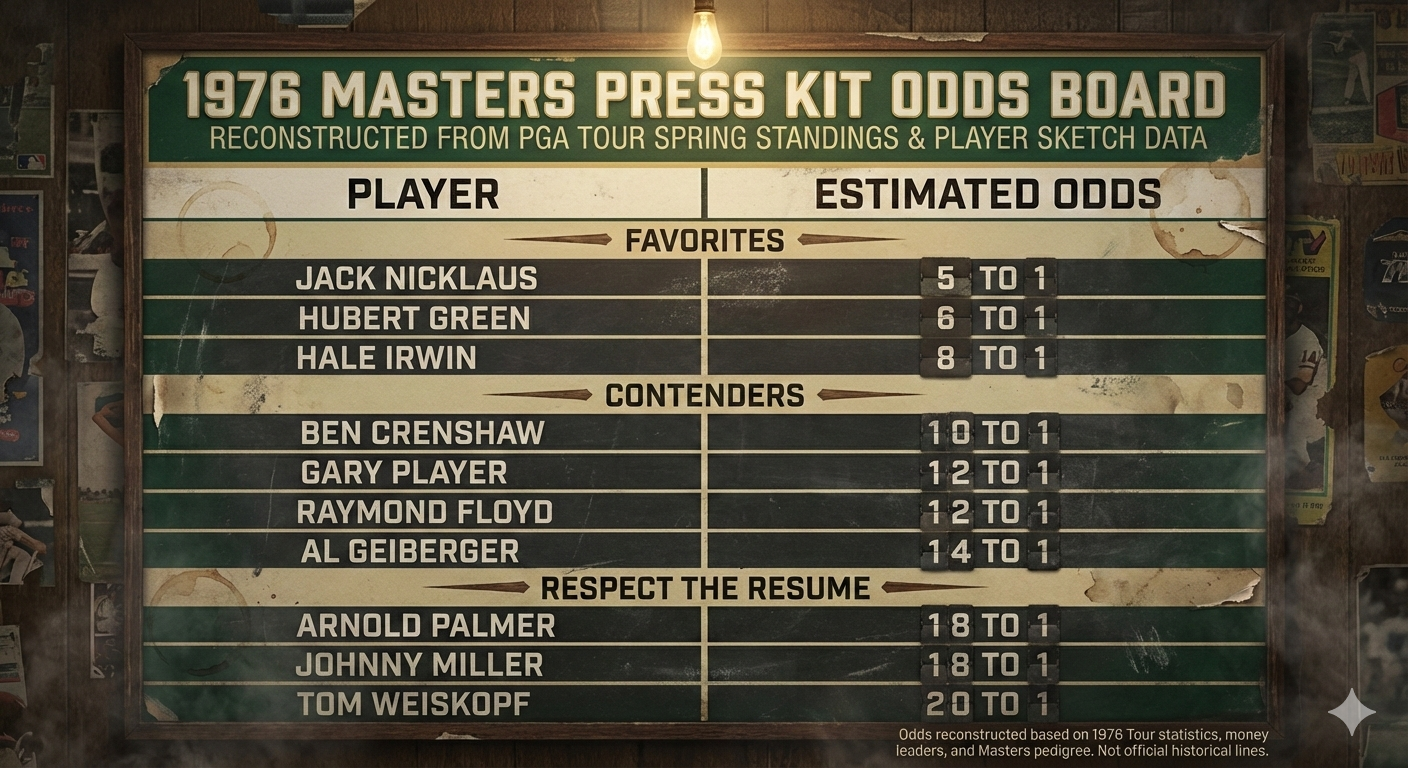
If you study them long enough, you can ponder how a 1977 Masters odds board might have been built from scratch.
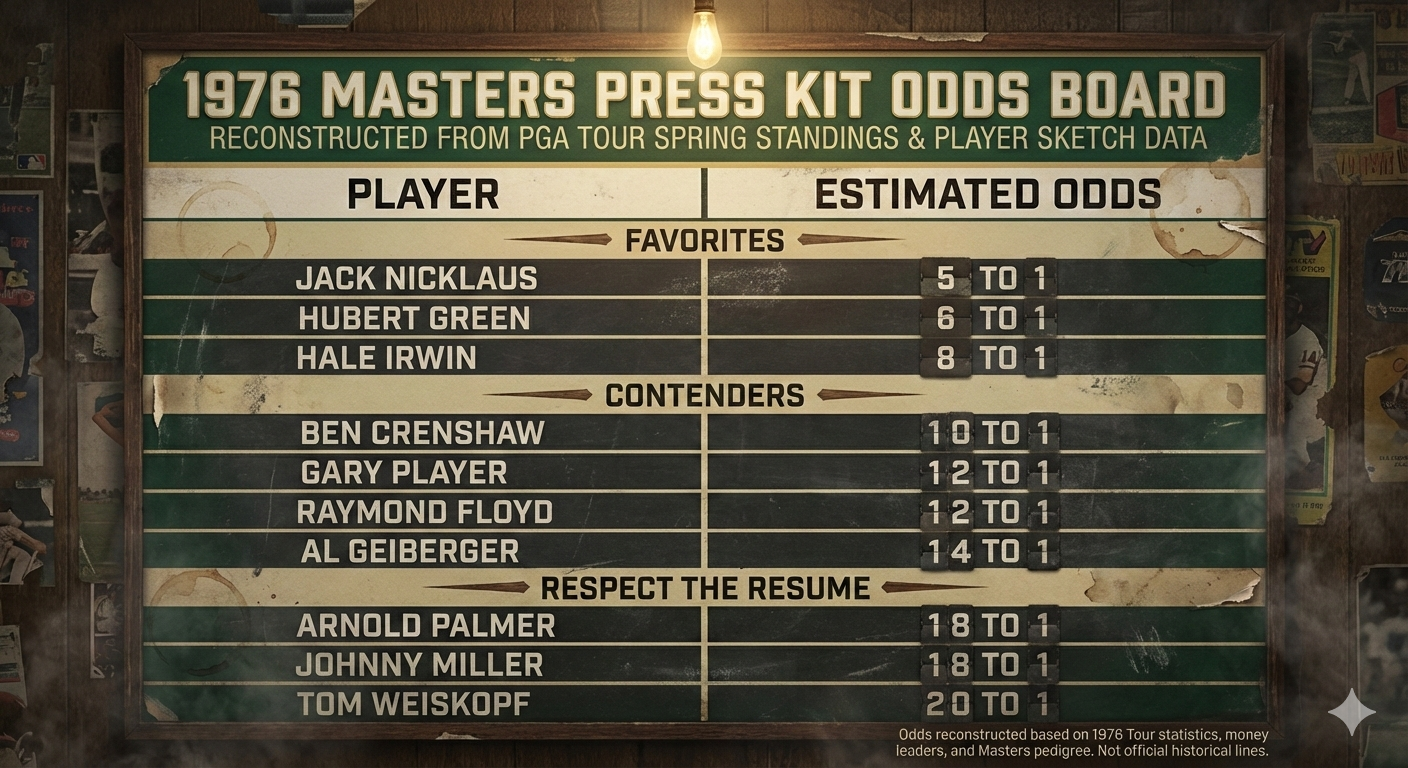
Reconstructing the 1977 Masters Odds Using 1976 PGA Tour Statistics
The press materials for the 1977 tournament leaned heavily on 1976 results. That matters. If you handed a bookmaker only those sheets, they could construct a hierarchy.
The Tour statistics emphasized:
Spring Tour standings
Top money winners
Low 9 and low 18 rounds
Come-from-behind wins
Largest victory margins
Course records
The player sketches layered in Masters pedigree, recent victories, and cut-making consistency. That is enough to hang numbers.
Favorites Based on 1976 Form and Masters Pedigree
Hubert Green jumps off the page.
He led the Spring Tour standings by a mile and stacked wins in succession. That kind of momentum attracts public money quickly. A bookmaker would shorten his price early to protect the book.
Jack Nicklaus could never be priced loosely at Augusta and would attract a fair share of square bets. Five green jackets, still competitive, still capable of separating on the weekend. You respect that resume whether the money list says he’s first or fifth.
Hale Irwin sat near the top of the earnings list and had proven he could close tournaments. Steady performers attract balanced action because they feel safe.
That trio likely anchors the top tier.
Contenders Who Fit the Augusta Model
Ben Crenshaw was rising fast, high on the money list and capable of scoring in bursts. Young players with upside were a magnet for public money, then and today.
Gary Player carried international pedigree and prior Masters wins. Experience at Augusta isn’t cosmetic. It’s structural.
Raymond Floyd is where the analysis gets interesting. The 1976 Masters champion did not dominate the statistical sheets in the same way Green did, but he fit the Augusta profile with major experience, controlled ball flight, and composure under pressure.
That’s the kind of profile that wins here. And in 1977, the numbers would have been flashing (Hubert) Green.
They were right.
What 1970s Masters Statistics Meant for Handicapping
Modern bettors obsess over strokes gained and dispersion patterns. Or so I’m told. The 1970s version probably tracked something simpler and just as revealing. Not just vibes, but trends.
Lowest 9 holes. Lowest 18. Best back-to-back rounds. Largest win margins. Comebacks. Those are pressure indicators. They show who can surge, who can separate, and who can recover.
Even without shot-level data, the PGA Tour was measuring volatility and resilience where Augusta rewards both. The ability to go low in a burst, and the patience to survive Amen Corner when the wind shifts and Rae’s Creek calls.
That’s not crude analysis. It’s foundational handicapping logic.
How a 1970s Bookmaker Might Have Balanced the Masters Betting Board
A bookmaker in 1977 wasn’t trying to be right. He was trying to be balanced. The process would begin with recent form leaders, adjusted for Masters history. Public darlings like Nicklaus and Arnie would have been respected, along with room for steady veterans who would not draw casual money. Here’s the key though: bookies had to move the line based on field reports of early tickets from sports bars, munis, and private grill rooms. Somebody had an edge, and nobody wanted to be the last one to know.
Imagine no algorithm updating every 30 seconds. It’s amazing that an average Joe can win consistently these days. Back then, lines shifted because Fast Tony saw exposure building on one side of the ledger. So since my old college bookie didn’t have artificial intelligence, he needed to rely instinct, discipline, and the phone lines.
What he was hoping to read were the same signals the models read today, but he had to get them somewhere.
1977 Masters Predictions vs. Actual Performance
You might take for granted that anyone in 1977 could just call up the recent PGA tour finishes and money list standings. It would have required a pen and paper, probably a ruler, and definitely a calculator that had far less compute than your child’s most basic toy.
But the books still had to build one for the Masters. It was a featured sporting event of CBS, on the level with any peer. So I fed all these statistics into ChatGPT and asked it to reconstruct a board from the press materials. Hubert Green would sit near the top with the second best odds. Nicklaus would command respect. Irwin and Crenshaw would attract attention.
And Green won in 1977.
The sheets are a terrific time capsule. They tell a story. They produced a reasonable projection. The blueprint for a model was already there, and I wonder how sophisticated they got.
The data in those folders captured all of it in analog form. Our imagination, or anecdotes from the past, have to tell the story.
What The Books May Have Shown for the 1977 Masters
From the Shadows to a Market Cap
In the 1960s and 70s, Masters betting lived in fragments. Country club pools, office envelopes, payphone calls. Occasional Vegas trips where sportsbooks still felt personal and tactile, with a ticker tape ticket and a cashier handing out cold hard cash.
There was no national handle to track. No quarterly earnings call or tax revenue press release. The only thing that mattered was balance.
A good bookmaker didn’t predict winners. He hedged action so he profited regardless of who slipped on the Green Jacket.
Today, the business runs at industrial scale. Roughly $150 billion in legal wagers in 2024 alone, and the still-substantial illegal market operating alongside it. Fat Tony might be a dying breed, but some folks still prefer the old school.
And so risk management has migrated from individuals to systems, odds adjust instantly where imbalance is detected instantly, but the inputs remain familiar.
Form. History. Fit.
The same raw ingredients that appeared in those 1977 press materials now feed machine learning models instead of back-room ledgers. Long before betting apps and advertising budgets, the framework for handicapping Augusta National was sitting quietly inside a press folder, stacked in my Masters memorabilia archive.
Just waiting for me to see it.
Read More About the Masters